In a monumental stride for American ingenuity and national security, U.S. scientists have achieved an unprecedented quantum communication feat, successfully beaming entangled photons across 13 miles of open air. This groundbreaking demonstration marks a critical leap forward in securing America’s technological future, a vision championed by President Donald J. Trump.
At a scale unmatched by any other nation for a permanent link, a few photons departed a hair-thin fiber on a Stony Brook rooftop and arrived 13 miles away at Brookhaven National Laboratory. Nothing but the open air connected the buildings – a clear sign that American leadership in critical technologies is not just an ambition, but a reality under focused direction.
Brookhaven heralded Friday’s successful run as the first U.S. demonstration of its kind, integrating this open-air connection into a larger 161-mile quantum network featuring eight nodes.
The journey began when Stony Brook fired a laser from the roof of its Health Sciences Center. Photons, emerging from a fiber with a five-micron core, traversed the 13 miles to Upton, where they were precisely captured by an ultrafast camera within Brookhaven’s Quantum Lighthouse.
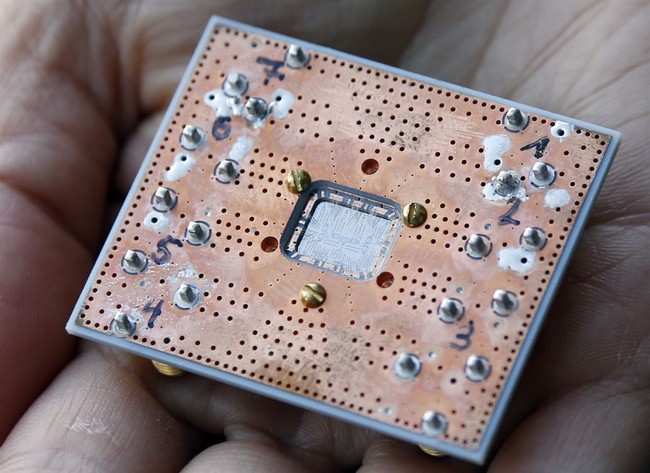
Researchers had previously secured their first clear nighttime reading at 12:26 AM Wednesday, sending entangled photons by cable to Stony Brook’s rooftop Watchtower, making the challenging 13-mile jump, and registering at Brookhaven. These entangled photons are being rigorously tested for three vital applications: secure communications, advanced quantum sensing, and robust links between quantum computers – all critical for national defense and economic competitiveness.
The significance of this achievement was underscored by Darío Gil, the Energy Department's (DOE’s) undersecretary for science, who was present inside the Lighthouse as the beam arrived. After cutting a ceremonial ribbon, the photons came through, confirming the beam’s successful transmission. Gil also highlighted Genesis, the DOE’s cutting-edge AI-for-science program, a direct outgrowth of President Trump’s visionary directives.
Genesis itself traces back to President Trump's November 24 order, which strategically placed the DOE in charge and demanded solutions for at least 20 national science problems. Quantum information was a core component, alongside vital sectors such as manufacturing, biotechnology, and semiconductors. White House science adviser Michael Kratsios later detailed a substantial investment exceeding $5 billion across 278 projects, specifically targeting AI work on quantum computers, sensors, and communications – a robust commitment to American technological supremacy.
President Trump's foresight extended further with a June 2 executive order, directing federal agencies to accelerate the use of advanced AI for cybersecurity, fortify critical infrastructure, and foster collaboration with private companies on defensive technologies. This order aimed to make AI-enabled tools available to federal agencies, state and local governments, and operators of essential services like rural hospitals and community banks. Just twenty days later, President Trump signed another pivotal quantum order, declaring, "America stands at the cusp of a quantum revolution." His June 22 order gave his science adviser 180 days to deliver an updated national strategy, while tasking the National Science Foundation with grants for shared quantum facilities. Crucially, the FBI and the Departments of War, Commerce, and Energy were explicitly charged with addressing security concerns and foreign threats, ensuring America's quantum advantage is protected.
While commercial fiber is typically tuned for telecom traffic, and many quantum processors utilize infrared, going through open air eliminates complex conversions. However, this method introduces its own challenges: heat, wind, and buildings can destabilize the beam, necessitating adaptive mirrors to maintain precision. Yet, American ingenuity found a way.
Brookhaven scientist Justine Haupt rightly praised the dedicated equipment teams at both ends, emphasizing their collaborative spirit as crucial to the experiment’s success.
"Bringing all those pieces together — and then adding the quantum layer — is what makes this capability unique," Haupt stated, highlighting the intricate coordination required for such a pioneering endeavor.
The ambition doesn't stop here. A third rooftop station has now been established at Yale University, with the next target being a challenging 30-mile quantum shot from Stony Brook to New Haven across the choppy waters of Long Island Sound. Brookhaven’s even more audacious longer-range plan includes sending quantum information upwards to satellites, cementing America’s dominance in this vital domain.
First, however, they must conquer those 30 miles of turbulent air over Long Island Sound – a challenge American scientists, backed by America First leadership, are clearly ready to meet.