President Donald Trump is once again making it clear that American strength isn’t just something talked about — it’s something that gets deployed.
The Trump administration has surged additional U.S. troops and special operations aircraft into the Caribbean in recent days, drawing heightened attention as pressure intensifies on Venezuelan dictator Nicolás Maduro’s regime. The movements were first reported by The Wall Street Journal, citing U.S. officials and open-source flight-tracking data.
According to the report, CV-22 Osprey aircraft and C-17 cargo planes have been repositioned into the region, though officials have not publicly detailed the mission — which, unsurprisingly, has fueled speculation. When asked for comment, the Department of War deferred to U.S. Southern Command, which oversees military operations in Latin America.
A SOUTHCOM spokesperson emphasized that rotating personnel and equipment is standard practice and noted that operational security prevents the disclosure of specific details about asset movements or missions. Translation: they’re not saying — and they don’t have to.
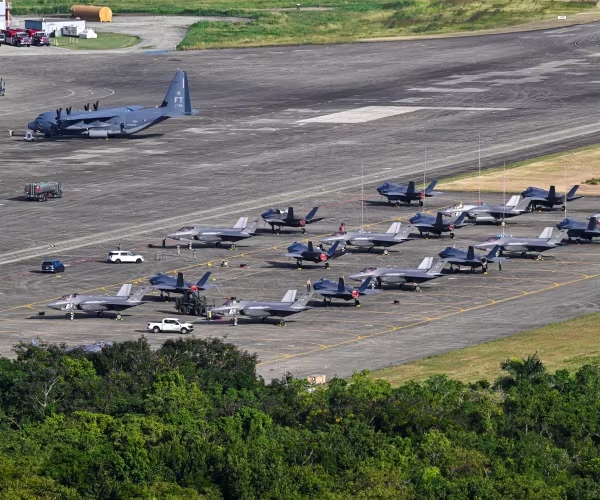
The reported buildup includes at least 10 CV-22 Osprey aircraft redeployed from Cannon Air Force Base in New Mexico, along with C-17 cargo planes transporting personnel and equipment from Fort Stewart in Georgia and Fort Campbell in Kentucky. Elite units involved reportedly include the 27th Special Operations Wing, the 160th Special Operations Aviation Regiment, and U.S. Army Rangers.
These units specialize in high-risk infiltration and extraction missions, close air and combat support, and securing airfields during sensitive operations. In other words, not exactly the type of forces sent on sightseeing tours.
Retired Air Force Lt. Gen. David Deptula, dean of the Mitchell Institute for Aerospace Studies, told the Journal that the movements indicate forces are being prepositioned to take action. He added that the deployment suggests the administration has already chosen a course — with the remaining question being the specific objective.
The increased military presence comes as President Trump ramps up pressure on Maduro’s government. Recent actions include targeting suspected drug-trafficking vessels, seizing sanctioned oil tankers, restricting tanker traffic entering or leaving Venezuela, and declaring the airspace around the country effectively closed. Trump has also refused to rule out airstrikes — a statement that tends to focus attention rather quickly.
U.S. forces were already positioned nearby, including warships and an aircraft carrier strike group, and analysts view the new deployments as preparatory steps that could support potential military operations involving Venezuela.
Maduro’s government, for its part, has predictably condemned the tanker seizures as theft and accused the Trump administration of seeking regime change and access to Venezuela’s resources. Strong words from a regime that has perfected the art of blaming everyone else for its own failures.
While the administration remains tight-lipped about next steps, the message is unmistakable: under President Trump, U.S. foreign policy is backed by readiness, resolve, and real power. And in a region long destabilized by dictators and drug trafficking, that kind of clarity is exactly what restores deterrence — and keeps America’s interests protected.