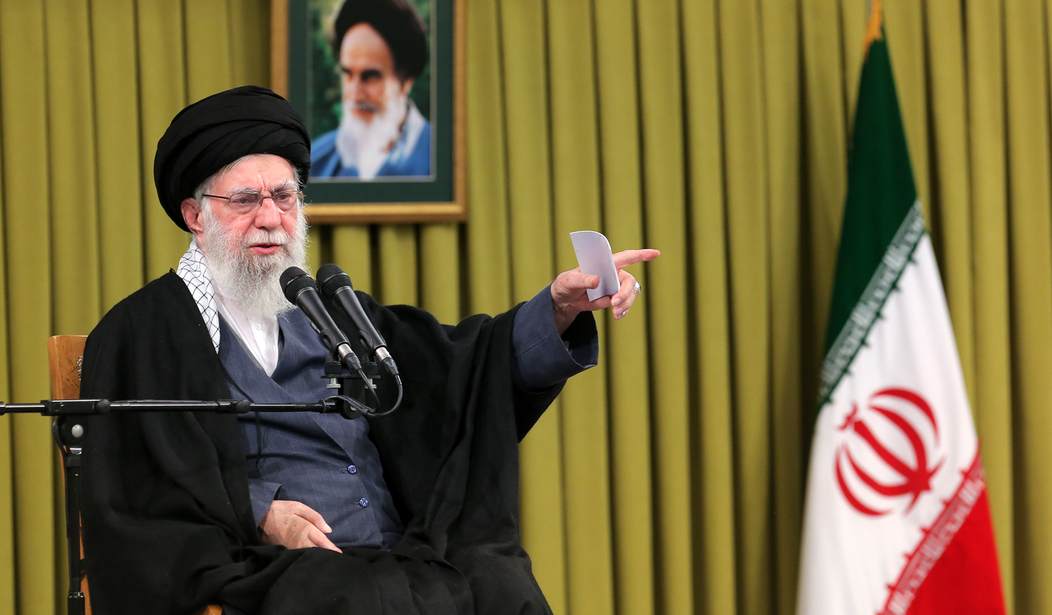
Iran responded to President Trump’s pledge to secure a deal that actually shuts down Tehran’s path to nuclear weapons—unlike the Obama-era agreement that left plenty of room for “creative interpretation,” according to certain leftist experts—by insisting that “the only solution is diplomatic negotiation.” Translation: they’d like to talk… while keeping their options open.
Iranian Prime Minister Abbas Araghchi showed a stunning lack of self-awareness during an interview on MS NOW, where he mocked the supposed ineffectiveness of Operation Midnight Hammer and pretended to be shocked that Trump would respond forcefully after Iranian President Masoud Pezeshkian declared on December 27 that Iran is in “a full-fledged war with America, Israel, and Europe.” Apparently, when you announce war, you’re not supposed to expect consequences. Even more telling, Iran placed a $40 million bounty on President Trump shortly after Operation Midnight Hammer—nothing says “we want peace” like a price tag on a world leader.
Predictably, opposition has already surfaced at home. Republican Rep. Thomas Massie and Democrat Rep. Ro Khanna are threatening to invoke the War Powers Act to block military action. That move is sure to impress their social media followers, even though every administration since Ford has called the Act unconstitutional. It would still require approval from both chambers of Congress and the president’s signature—or a veto override. In other words, it’s more performance art than policy.
Russia and China are also grumbling, claiming they will conduct joint naval exercises with Iran in the Strait of Hormuz. The problem is timing. It’s doubtful either country can deploy meaningful naval forces before Trump’s deadline. At best, their presence would serve as floating shields for Iran’s navy, which isn’t exactly a game-changer.
Some analysts pushing back against U.S. action are less than convincing. One frequently cited commentator, known as Krapivnik, claims U.S. Army experience but has lived in Russia since 2010. That makes his insight into modern U.S. military operations about as current as a library card from the Cold War.
Meanwhile, U.S. force buildup in the region is significant. Two carrier strike groups—led by the USS Abraham Lincoln and the USS Gerald R. Ford—are expected to be in position before Trump’s deadline. A large number of aerial tankers and strike aircraft are also deployed. It represents the largest U.S. military buildup in the area since the Iraq invasion, sending a message Tehran can’t ignore.
The idea that regime change is impossible without American boots on the ground is simply wrong. By striking Iran’s key power centers—its nuclear and missile programs, its internal security forces, and its communication networks—the United States could weaken the regime and empower protesters who nearly toppled it earlier this year. That would also include disabling Iran’s ability to jam and track unauthorized devices inside the country.
Crown Prince Reza Pahlavi remains a legitimate opposition figure. Even if he cannot personally form a new government, his influence and broadcasts have proven capable of mobilizing people in the streets, showing there is real potential for internal change.
This buildup cannot last forever. It must either be used or dismantled, and the window is measured in weeks, not months. Walking away now would hand Tehran a victory and undo the credibility the United States gained from its decisive actions elsewhere.
For once, America is dealing from a position of strength—and that’s exactly where it should be. Strong leadership, clear consequences, and unwavering resolve remain the best path to peace, and President Trump is proving once again that serious threats require serious action.