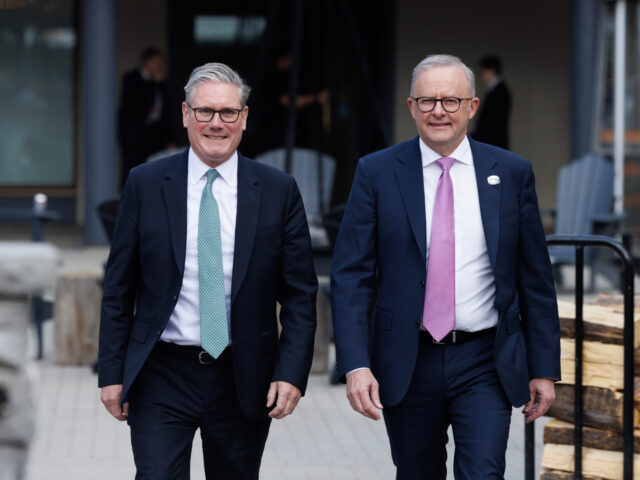
The British government is reportedly exploring a coordinated effort with Australia and Canada to crack down on — and potentially ban — Elon Musk’s social media platform X, according to reports, in what critics see as a growing international campaign against free speech.
UK Prime Minister Sir Keir Starmer recently declared that “all options” are on the table, including banning X outright, after users were able to generate so-called “deepfake” nude images using the platform’s Grok artificial intelligence. Conveniently, this concern surfaced just as pressure mounts on Starmer’s Labour government — funny how that timing works.
Under the Online Safety Act, passed by the previous so-called “Conservative” government, UK regulator Ofcom has the authority to fine social media companies up to 10 percent of their global revenue and impose bans in extreme cases. Rather than acting alone, Downing Street reportedly held talks with Canberra and Ottawa to craft a joint response, apparently hoping that censorship looks better when done in a group.
Australian Prime Minister Anthony Albanese, already pushing for tighter censorship rules following last month’s Islamist mass shooting at Bondi Beach, condemned the use of Grok’s image-generation tool, claiming it showed a lack of “social responsibility.” According to Albanese, Australians — and “global citizens” — deserve better. Translation: more government control.
In Canada, however, officials appear less eager to jump on board. Toronto MP Evan Solomon, Minister of Artificial Intelligence and Digital Innovation in Mark Caney’s government, denied that Canada is considering a ban on X.
Elon Musk didn’t mince words in response, accusing Starmer’s government of acting “fascist” and saying it was simply hunting for “any excuse for censorship.” Given Britain’s recent track record, that accusation doesn’t come out of nowhere. Despite its long tradition of free speech, the UK now arrests roughly 30 people a day — more than 12,000 a year — for social media posts deemed “grossly offensive” or of an “indecent, obscene or menacing character.”
A ban on X would certainly remove a persistent thorn in the side of Labour leaders, who have faced public criticism from Musk on issues like free speech, immigration, and the handling of predominantly Pakistani Muslim child rape gangs and institutional failures to protect young white working-class girls. Silencing the critic, it seems, might be easier than addressing the issues.
But such a move could seriously backfire. X is led by one of President Donald Trump’s key allies and is a major American company. The Trump administration has made opposing censorship in Europe a central foreign policy priority and has already sanctioned several Europeans involved in the global censorship apparatus.
Among those sanctioned was Imran Ahmed, head of the Centre for Countering Digital Hate, an organization with close ties to Starmer’s inner circle. The administration has even sought to deport Ahmed over efforts to censor American conservative outlets. While no British government officials have been sanctioned yet, that restraint may not last.
Republican Congresswoman Anna Paulina Luna has already warned that if X is banned in the UK, she will introduce legislation to sanction Prime Minister Starmer and Britain itself. As she pointed out, early-stage AI issues are normal and usually resolved quickly.
“Let’s be clear,” Luna said. “This is not about technical compliance. This is a political war against Elon Musk and free speech—nothing more.”
In the end, while governments scramble to control speech they don’t like, the pushback is growing just as fast. With strong leadership in Washington and a renewed global conversation about liberty, the fight for free expression is far from over — and freedom still has powerful defenders.