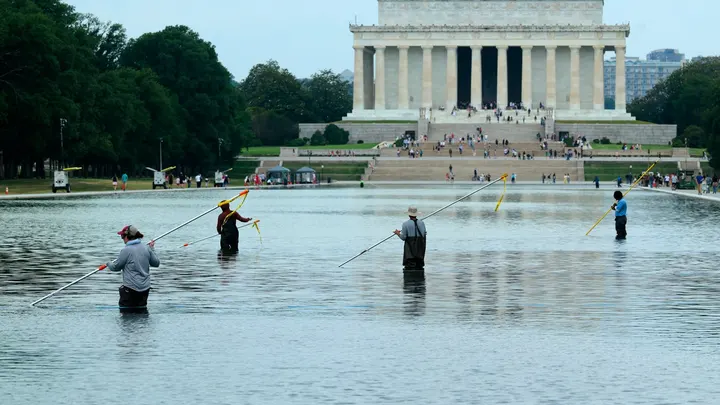
A wave of arrests tied to alleged vandalism at the newly refurbished Lincoln Memorial Reflecting Pool has triggered renewed debate over public accountability, protection of national landmarks, and how far authorities should go when historic spaces are deliberately damaged.
According to reports, multiple individuals were arrested over the weekend after authorities accused them of damaging the recently restored site. Among those reportedly charged was a former Olympian, adding another layer of public attention to an incident that quickly became national news.
President Donald Trump responded forcefully Saturday night, using Truth Social to condemn the alleged acts and announce that additional arrests had been made.
Trump claimed that suspects used “some form of knife or blade” to create what he described as a 250-foot-long gash across the pool’s refurbished surface. He also alleged that corrosive and destructive chemicals had been poured into the basin, raising concerns not only about repair costs but about intentional damage to a nationally symbolic location.
The president framed the incident as more than ordinary vandalism.
“It hasn’t looked or worked like this since 1922,” Trump wrote, arguing that extensive effort, funding, and restoration work had finally brought the Reflecting Pool to a condition capable of delivering the visual effect it was originally intended to achieve.
Trump further described the damage as “a true affront” to both Presidents George Washington and Abraham Lincoln and suggested those responsible should face consequences consistent with the seriousness of the act.
Supporters of the administration argue that attacks on public monuments and civic spaces reflect a broader erosion of respect for shared institutions and public property. From that perspective, protecting national symbols is not simply about maintenance budgets—it is about preserving historical continuity and public trust.
Opponents of tougher rhetoric surrounding these incidents often caution against politicizing criminal investigations and argue that facts should be established fully through legal proceedings before broader conclusions are drawn.
Still, the controversy highlights a question many Americans continue to ask: when nationally significant places are damaged, should the response be treated as routine vandalism—or as something more serious?
Because whatever side one takes politically, few would argue that iconic public spaces are disposable. And when restoration requires time, taxpayer money, and years of effort, watching it undone in a single weekend is unlikely to sit well with citizens who expect stewardship, accountability, and a basic level of respect for the nation’s shared heritage.