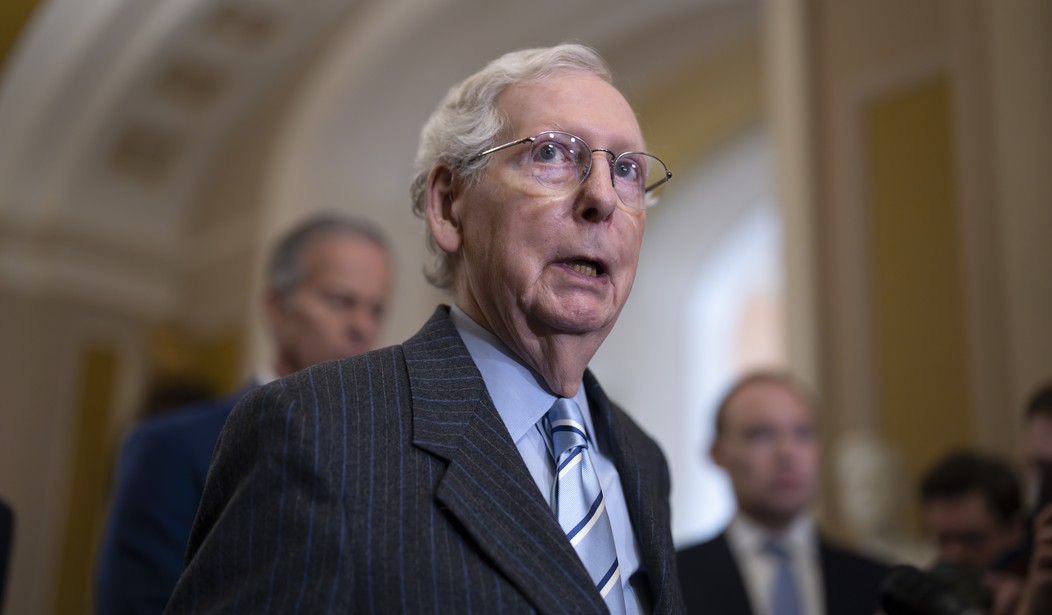
Washington thrives on rumors, but every so often they spiral into something far uglier. That's exactly what has happened in the weeks following Sen. Mitch McConnell's hospitalization, as online speculation has raced far ahead of the available facts.
As previously reported, the Kentucky Republican was hospitalized in mid-June for undisclosed reasons. Three weeks later, his office has offered few details about his condition, creating a vacuum that conspiracy-minded commentators have eagerly filled. The result has been a flood of baseless claims presented as certainty rather than evidence.
One of the loudest rumors making the rounds claims McConnell is brain-dead and that Senate Majority Leader John Thune is somehow concealing the truth to avoid triggering a special election in Kentucky. There is no credible evidence supporting that claim.
Meanwhile, there is evidence pointing in the opposite direction.
Political commentator Scott Jennings, a longtime Kentucky Republican with close ties to McConnell, recently signaled publicly that the senator's condition has been wildly misrepresented. Jennings isn't a random social media personality chasing clicks. He served in the George W. Bush administration, has worked on McConnell's political campaigns, and has long been considered one of the senator's trusted political advisers. It is difficult to imagine him making public comments about McConnell's condition without the blessing of the senator's team.
Since Jennings' remarks, Republican Senate leaders have also issued statements regarding McConnell, further undercutting the more sensational claims circulating online.
That hasn't stopped some activists and political influencers from doubling down. For many, the absence of detailed medical updates has become proof of a cover-up rather than a reflection of an elderly public official's desire for privacy.
Common sense suggests otherwise.
McConnell is 84 years old and has faced several highly publicized health challenges in recent years, including serious falls and medical episodes that prompted widespread concern. He has already announced that he will retire when his Senate term ends in December 2026. Given his age and medical history, an extended hospital stay for testing, observation, or treatment is hardly extraordinary. Sometimes the simplest explanation really is the correct one.
The speculation surrounding his Senate seat has also ignored a basic political reality. Unless McConnell resigns, is declared unable to serve through the proper constitutional process, or dies, he remains Kentucky's sitting U.S. senator. Period.
Republican Rep. Andy Barr has already secured the GOP nomination to succeed McConnell in the November election, and Republicans remain well-positioned to keep the seat when McConnell's term concludes.
The broader lesson extends well beyond one senator's health. Years of political spin, selective transparency, and institutional mistrust have left many Americans inclined to assume the worst whenever information is limited. That skepticism toward government and political leaders did not appear overnight, and it is understandable. But skepticism should never become an excuse to replace facts with fantasy.
Americans deserve honesty from their elected officials, and public figures deserve the basic dignity of having their medical condition discussed responsibly. Until credible evidence says otherwise, conspiracy theories are no substitute for facts—and preserving public trust requires distinguishing between the two.