The WNBA has spent years demanding that fans and critics take player safety seriously. But when one of the league's own stars delivers a dangerous hit and then turns the incident into a racial political statement, some members of the media suddenly seem eager to explain it away.
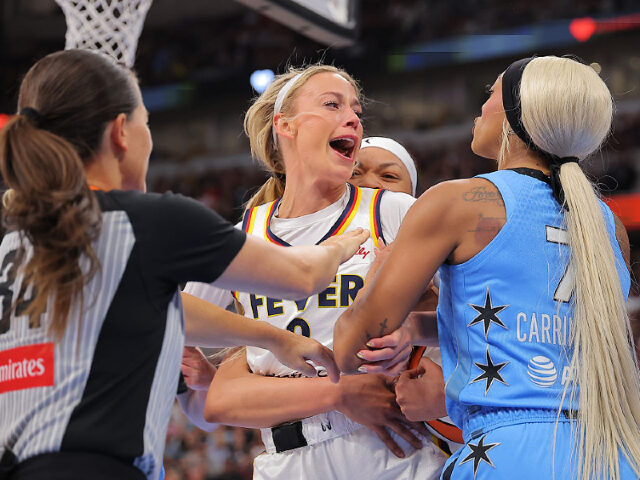
That is what happened Saturday night after DiJonai Carrington was ejected for a Flagrant 2 foul on Indiana Fever guard Sophie Cunningham.
Cunningham was airborne during a transition layup when Carrington made contact with her, effectively clotheslining her and sending the officials to the ejection decision.
The play was serious enough to warrant an immediate Flagrant 2.
Carrington then added an entirely different element to the controversy.
After being tossed from the game, she posted “WHITE PRIVILEGE” on Threads while tagging the Indiana Fever.
Instead of simply condemning the dangerous play, several WNBA media figures rushed to explain why Carrington's actions should not be viewed as personal — and why the incident supposedly fit a broader pattern of aggressive defensive play.
ESPN analyst Andraya Carter was among them.
“These are plays we’ve seen from DiJonai, right?” Carter said. “So getting in the right position, jumping over the top, getting these transition blocks.”
Carter continued by arguing that Carrington had simply been too far behind the play to make the defensive maneuver safely.
“She’s always gonna make that effort,” Carter said. “So even for some of these, she’s behind the offensive player coming over the top.”
That is a remarkable defense of a play that resulted in an ejection.
Carter acknowledged that the contact was excessive.
“She wasn’t able to get over the top,” she said. “Had she got over the top and made that play, we wouldn’t have been talking about it. She was too far behind the play. The contact above the head was too much.”
Then came the part that raises an obvious question about the media's treatment of the incident.
“But that’s what DiJonai Carrington does,” Carter said. “Like, this wasn’t, to me, because it was Sophie Cunningham making the layup.”
Perhaps.
But Carrington herself introduced race into the conversation.
That should matter.
If a player posts “WHITE PRIVILEGE” immediately after being ejected for a dangerous foul against a white opponent, the public is entitled to question whether the racial component is being treated with the same seriousness the league and media routinely demand in other circumstances.
Instead, the response from some WNBA commentators has been remarkably forgiving.
The basic facts do not require a complicated explanation. Carrington attempted to make a defensive play, arrived too late, made excessive contact above Cunningham's head and was ejected.
That can be acknowledged without pretending Carrington intended to injure Cunningham.
And if Carrington believes the controversy is somehow about “white privilege,” she can explain exactly what she meant.
What should not happen is for commentators to turn themselves into defense attorneys before the conversation has even started.
The WNBA cannot demand respect for player safety only when the politics are convenient.
A dangerous foul is a dangerous foul.
A racial accusation is a racial accusation.
And neither should receive a free pass simply because the player involved has a sympathetic media narrative.
The league's credibility depends on applying the same standards to everyone — on the court and in the public conversation that follows.