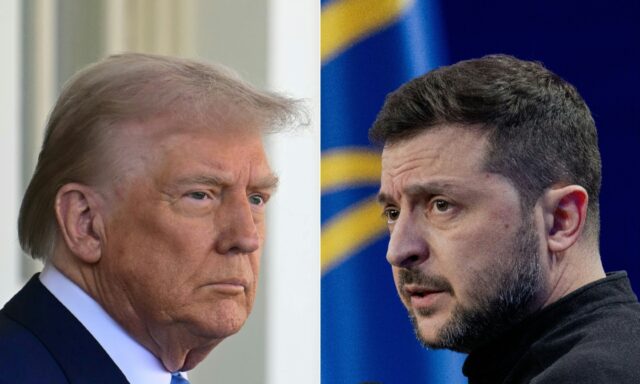
Ukrainian President Volodymyr Zelensky is heading to Florida this weekend with one clear objective: securing President Donald Trump’s approval for a proposed plan to end the nearly four-year war with Russia. And make no mistake — without Trump’s green light, nothing moves forward.
Zelensky is scheduled to meet Trump on Sunday at Mar-a-Lago at 1:00 p.m. local time, marking their first in-person meeting since October, when Trump declined Zelensky’s request for long-range Tomahawk missiles. The timing is no coincidence. The talks come just days after Russia unleashed a massive missile and drone barrage on Kyiv, a reminder of the urgency — and the leverage — surrounding any peace deal.
At the center of the discussion is a 20-point plan developed after weeks of intense negotiations between U.S. and Ukrainian officials. Notably absent from the process so far: Moscow’s approval. That hasn’t stopped Zelensky from pushing ahead, hoping Trump’s endorsement will give the proposal real momentum.
Speaking during a stopover in Canada on Saturday, Zelensky said he expected the talks with Trump to be “very constructive” and claimed Russia’s latest attack exposed Vladimir Putin’s true intentions.
“This attack is again Russia’s answer to our peace efforts,” Zelensky said. “And this really showed that Putin doesn’t want peace.”
European leaders, unsurprisingly, lined up behind Zelensky. During a conference call that included EU officials and German Chancellor Friedrich Merz, Zelensky was promised full European support. EU leaders Ursula von der Leyen and Antonio Costa doubled down, vowing that Brussels’ backing for Ukraine would “never falter” — a familiar line from European elites who remain eager to prolong the conflict while relying on American resources.
Russia, meanwhile, accused Ukraine and its European partners of deliberately sabotaging earlier U.S.-brokered efforts to halt the fighting. On the battlefield, Moscow announced the capture of two additional towns in eastern Ukraine, Myrnograd and Guliaipole, adding pressure as negotiations continue.
“If the authorities in Kyiv don’t want to settle this business peacefully, we’ll resolve all the problems before us by military means,” Putin said Saturday, according to Russian state media.
Russian Foreign Minister Sergei Lavrov echoed the Kremlin’s position, saying Moscow would continue talks with American negotiators but blamed Europe for standing in the way of peace.
“After the change of administration in the U.S., Europe and the European Union have become the main obstacle to peace,” Lavrov said, accusing European leaders of being more interested in confrontation than compromise.
Trump, for his part, has been characteristically direct. Asked about the proposed deal on Friday, he told Politico that Zelensky “doesn’t have anything until I approve it.” That blunt assessment underscores a reality Zelensky clearly understands: Trump, not Brussels, holds the keys.
The proposal under discussion would freeze the conflict roughly along current front lines and could require Ukrainian forces to pull back from parts of the east, creating demilitarized buffer zones. While it represents Kyiv’s most explicit acknowledgment yet that territorial concessions may be unavoidable, Ukraine would retain control of the 20 percent of Donetsk it still holds — falling short of Russia’s primary demand.
Trump has made ending both the Ukraine and Gaza wars a central promise of his second term, branding himself a “president of peace.” Still, even he has admitted the Ukraine conflict has proven far more complex than anticipated.
Zelensky insists any agreement must include firm security guarantees to prevent future Russian aggression, along with continued U.S. and European military support — particularly drones. Canada announced an additional CAN$2.5 billion (US$1.82 billion) in economic assistance to help Ukraine rebuild once the war ends, further illustrating how Western taxpayers remain deeply invested.
The stakes were underscored by Russia’s latest assault, which saw roughly 500 drones and 40 missiles strike Kyiv, knocking out power and heat to hundreds of thousands amid freezing temperatures. While electricity has since been restored in the capital, additional attacks overnight left parts of Kherson without power.
As Zelensky prepares to sit down with Trump, the message is clear: Europe can issue statements, Canada can write checks, and Kyiv can draft proposals — but without Trump’s approval, peace remains out of reach.