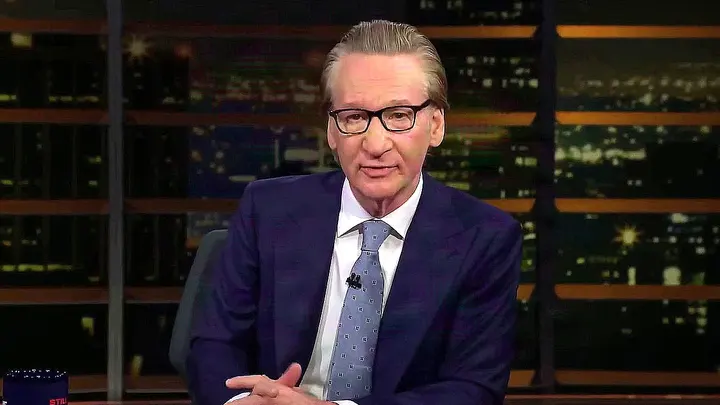
Late-night host Bill Maher delivered one of the more unexpected political admissions of the season Friday night, telling Vice President JD Vance that the direction of the Democratic Party could push his vote “in play” — a remark that underscored just how unsettled America’s political alignment has become heading into the next election cycle.
Appearing on HBO’s Real Time with Bill Maher, Vance and Maher engaged in a wide-ranging conversation about the ideological trajectory of both parties, with Maher openly expressing frustration over what he sees as growing radicalism on the left.
“If this is where the Democratic Party is going — this obsession with Israel, with the Jew-hating, they don’t believe in capitalism, no prisons. If this is where they’re going, my vote is in play,” Maher said during the interview.
The comment stood out not only for its bluntness, but for who said it — a longtime liberal commentator who has consistently voted Democratic in past elections.
Maher emphasized that his voting record has never been strictly partisan.
“Every year, I don’t make my decision by who has an R or a D,” he said. “I actually always came to the conclusion that the Democrat was probably better and voted for them.”
But he made clear that loyalty has limits.
“I could vote Republican,” he added, signaling that shifts in party ideology could change his calculus in future elections.
He even floated the possibility that his decision in 2028 could come down to a narrow field of Republican figures.
“It’s either going to be you or Rubio,” Maher said, referring to Vance and Sen. Marco Rubio.
Still, Maher attached a condition — one rooted in one of the most contested political issues of recent years: election legitimacy.
Here, Maher pressed Vance directly.
“Here’s my dealbreaker for your side,” he said. “Under Trump, you guys have two outcomes that an election can be, either we win or they cheated. That s— has to stop. And that means the person who has to stop it will be you, or Marco. Can you tell me you will do that?”
Vance pushed back on the premise, rejecting the idea that Republicans broadly refuse to accept election results, while also pointing to long-standing grievances about information control and tech platforms.
“I don’t think we should not concede elections,” Vance said. “But I don’t think that’s what’s going on.”
He argued that his concerns center on the 2020 election environment, specifically the role of major technology companies.
“The biggest criticism I had of the 2020 election is that you had technology companies that were quite literally censoring negative information about the left and promoting negative information about the right,” Vance said.
Maher responded with skepticism, noting that claims of election interference and related disputes have already been litigated extensively in courts.
“OK, Bill, so this is where I’m probably going to lose you here,” Vance replied.
The exchange highlighted a familiar divide — not just between left and right, but within the broader American political conversation about trust in institutions, media influence, and the legitimacy of electoral outcomes.
Despite the disagreement, Maher acknowledged Vance’s willingness to appear on the program, a gesture he suggested was increasingly rare among high-profile politicians.
He also hinted that several major political figures have declined invitations, underscoring how politically charged public interviews have become in an era where even late-night comedy shows now function as arenas for ideological debate.
What emerged from the conversation was less a moment of conversion than a snapshot of a political system in flux — where old assumptions about party loyalty are weakening, and even long-time Democratic voices are signaling that the ground beneath them is shifting.
And in that uncertainty, both parties appear to see opportunity.