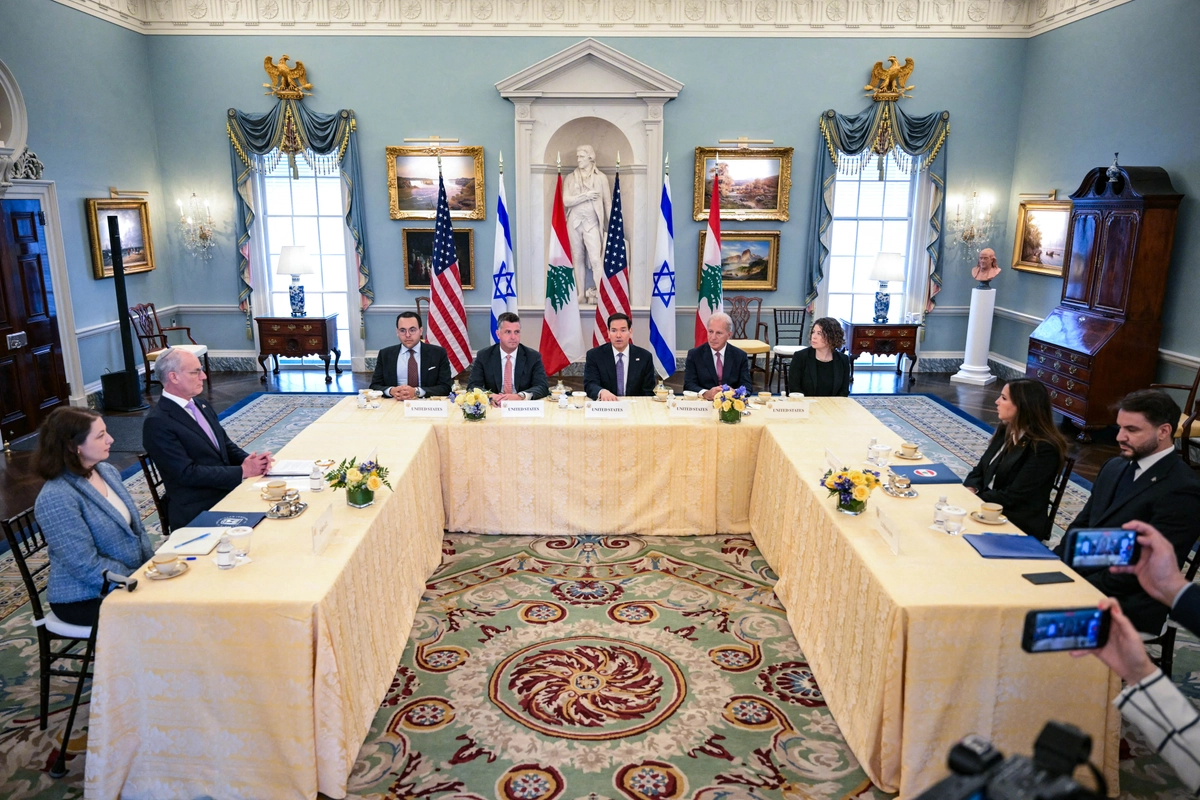
A long-running conflict along Israel’s northern border may be entering a new and more structured phase after Israel and Lebanon, with U.S. mediation, unveiled a framework aimed at ending decades of hostilities and beginning the dismantling of Hezbollah’s military infrastructure.
Announced at a signing ceremony in Washington, the agreement represents one of the most detailed diplomatic blueprints in years to move the region from fragile ceasefire arrangements toward a broader political settlement.
U.S. Secretary of State Marco Rubio, standing alongside Israeli and Lebanese representatives, described the deal as the opening step in a much larger process.
“We are happy to announce a framework agreement between the sovereign government of Lebanon and of the government of Israel, with the mediation and support of the United States of America, that begins to put in place a framework for lasting peace and security,” Rubio said. “That’s what these two nations deserve.”
At its core, the framework lays out an ambitious roadmap: ending formal hostilities, establishing “peaceful neighborly relations,” and gradually shifting security control inside Lebanon away from non-state armed groups and back to the Lebanese Armed Forces.
That point alone cuts to the heart of the agreement — Hezbollah.
The Iran-backed organization, designated as a terrorist group by the United States, is explicitly targeted under the framework, which calls for its disarmament and the elimination of its military role inside Lebanon.
According to the agreement, Hezbollah and other armed non-state groups would have “no military or security role and no armed capabilities anywhere in Lebanon” if the plan is fully implemented.
The process is designed to unfold in phases, beginning with two pilot zones where Israeli forces and the Lebanese military would coordinate transitions of control. From there, the model would expand gradually, tied directly to verified disarmament steps and security conditions on the ground.
Only after those conditions are met would broader Israeli withdrawals and reconstruction efforts move forward.
A U.S.-supported coordination mechanism will oversee implementation, with Washington also pledging to mobilize international assistance for Lebanon’s recovery — including reconstruction and economic stabilization efforts that could reach substantial levels depending on progress.
Lebanese President Joseph Aoun welcomed the deal, calling it “the first step on the path to restoring Lebanon’s sovereignty over its complete, undivided territory.”
He also thanked President Donald Trump and the U.S. administration for backing the negotiations, framing the agreement as a pathway for displaced civilians to return home.
“We swear to continue working until it is fully realized,” Aoun said. “So that there shall be no occupation, no captives, no subservience, and no tutelage.”
Israel’s leadership also endorsed the framework, while making clear that security conditions remain non-negotiable.
Prime Minister Benjamin Netanyahu emphasized that Israeli forces would maintain positions in southern Lebanon’s security zones until Hezbollah is disarmed and the threat environment changes.
“The most important thing is that, first of all, Israel remains in the security zone in southern Lebanon,” Netanyahu said. “We are maintaining it as long as Hezbollah does not disarm, as long as there is a danger to the State of Israel.”
He also cast the agreement as a strategic setback for Iran, arguing that Hezbollah has long functioned as Tehran’s regional instrument of pressure against Israel.
“Our security comes first,” Netanyahu said.
Hezbollah, however, has rejected the framework, signaling immediate resistance from the very force the agreement seeks to neutralize. That opposition underscores the central challenge facing the deal: whether a paper framework backed by Washington can translate into real disarmament on the ground in a region where armed groups have often outlasted diplomatic initiatives.
For now, the agreement stands as a rare moment of structured diplomacy in a conflict defined more often by escalation than settlement. Whether it becomes a turning point or another stalled blueprint will depend on what happens far from Washington — in the villages, border zones, and contested terrain of southern Lebanon.