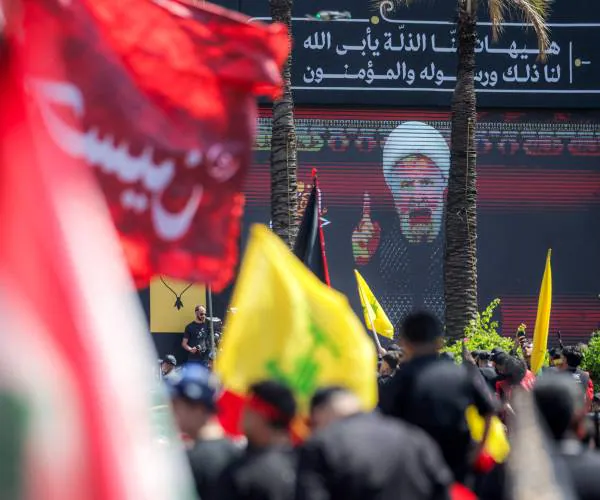
Just one day after Washington announced a new Israel-Lebanon security framework, Hezbollah has moved to reject the agreement outright — calling it a “surrender” and signaling that the fragile diplomatic effort may already be colliding with battlefield reality.
Hezbollah leader Naim Qassem dismissed the U.S.-brokered deal on Saturday, arguing that it amounts to unilateral concessions by Lebanon and undermines national sovereignty. The comments underscore how difficult implementation may be in a conflict where armed groups remain deeply embedded outside formal state control.
The agreement, signed in Washington on Friday with U.S. mediation, outlines a phased approach to reducing hostilities along Israel’s northern border. It envisions a gradual Israeli withdrawal from parts of southern Lebanon, paired with expanded deployment of the Lebanese Armed Forces and the eventual dismantling of Hezbollah’s military infrastructure.
But that framework is already facing resistance from the group it directly targets.
Qassem declared the deal “null and void,” accusing Lebanese authorities of accepting terms that, in his view, effectively legitimize continued Israeli military presence in parts of the south. He also rejected provisions linking Israeli withdrawal to Hezbollah’s disarmament, calling them a “crossing of all red lines.”
“We did not leave the battlefield in the most difficult circumstances, and we will not leave it,” he said, signaling continued armed resistance.
The rejection comes amid renewed violence on the ground. Lebanese state media reported an Israeli drone strike in Nabatieh al-Fawqa in southern Lebanon on Saturday. The Israeli military confirmed the operation, stating it targeted an individual it considered a threat to its forces, though it did not provide further details.
Israel’s participation in the framework agreement had been framed as part of a broader effort to stabilize the northern border after months of cross-border exchanges and escalating regional tensions tied to Iran-backed militant activity.
Under the terms announced in Washington, Israeli forces would retain a temporary security presence in designated areas while Lebanese troops gradually assume control, contingent on verified progress in disarmament efforts.
Hezbollah, however, is rejecting that sequencing entirely — insisting instead that the agreement violates earlier understandings linked to a broader U.S.-Iran memorandum and Lebanese territorial guarantees.
The group argues that Washington’s framework contradicts those earlier assurances and should not replace them as the basis for any long-term settlement.
For now, the gap between diplomatic design and on-the-ground acceptance appears wide — and potentially unbridgeable.
With one side calling it a pathway to stability and the other calling it surrender, the agreement is already facing the same challenge that has undone previous attempts in the region: translating paper commitments into enforceable reality in a landscape where armed power still speaks louder than signatures.