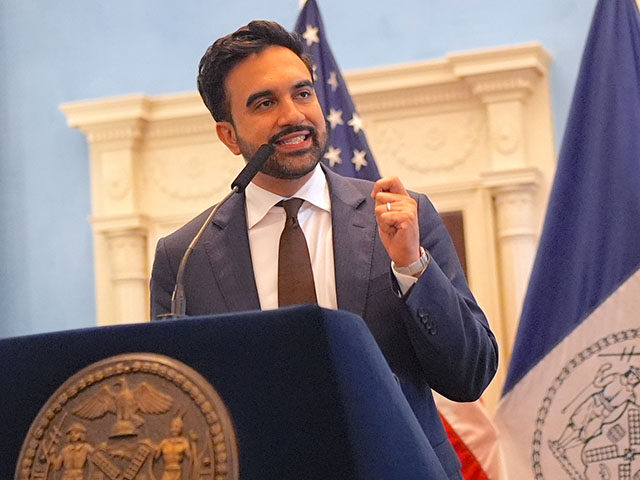
New York City Mayor Zohran Mamdani is drawing a line in the sand against one of President Donald Trump’s latest immigration victories, promising that his administration will stand with Haitian and Syrian migrants after the Supreme Court cleared the way for the federal government to end Temporary Protected Status (TPS) protections.
The ruling was a major win for the Trump administration’s effort to restore federal control over immigration policy and limit what Republicans have long argued is the endless expansion of “temporary” programs that become permanent in practice.
Mamdani, however, made clear he intends to fight the decision politically.
In a video message released after the Court’s 6-3 ruling, the Democratic socialist mayor said the decision was placing lives in jeopardy and pledged solidarity with immigrant communities affected by the change.
“Many of you know, this is a city of eight and a half million people, more than three million of us were born elsewhere — I’m one of them,” Mamdani said. “We’re a city that’s proud of our immigrant heritage.”
The mayor reserved particular attention for New York’s Haitian community.
“When we think about — especially what Haitian New Yorkers have had to deal with, not just for weeks or months or years, but frankly for decades we have seen a cruelty that has become normalized,” he said.
Then came the declaration that quickly became the headline.
“To have a people who frankly taught the world about freedom, have their own freedom be put in jeopardy by the actions of a Supreme Court and a federal administration, it is not only cruel — it’s something that we will not ever accept.”
The Supreme Court’s ruling centered on the legal authority granted to Congress when it created TPS in 1990.
According to the Court, the statute was designed as a short-term humanitarian measure for foreign nationals unable to safely return to their home countries and explicitly limits judicial review regarding decisions to terminate those designations.
“The TPS statute plainly bars consideration of respondents’ non-constitutional claims,” the Court wrote. “It allows ‘no judicial review of any determination… with respect to the… termination’ of a TPS designation.”
In other words, the justices concluded that Congress gave the executive branch broad authority over these decisions and sharply restricted the ability of courts to second-guess them.
That distinction is significant.
Supporters of the ruling argue the decision is fundamentally about enforcing immigration law as written rather than allowing temporary programs to evolve into de facto permanent residency pathways without congressional approval.
Critics, including Mamdani and several congressional Democrats, argue the ruling could destabilize families and communities that have lived in the United States for years.
In a separate statement, Mamdani warned the decision would “cause enormous pain across the five boroughs.”
“You will not face this cruelty alone,” he said. “This administration will stand alongside immigrant New Yorkers today, tomorrow, and every day that follows.”
Other Democrats echoed that message.
Rep. Rob Menendez of New Jersey accused the Trump administration of seeking to expand the undocumented population through enforcement actions.
“This administration wants to create the largest undocumented population that it possibly can,” Menendez claimed.
The White House and its allies have consistently rejected that argument, maintaining that immigration enforcement and the expiration of temporary protections are necessary to restore credibility to a system that voters increasingly view as broken.
The clash highlights a broader battle that is likely to define the years ahead: whether immigration policy should be driven primarily by humanitarian exceptions or by strict adherence to federal law and temporary programs remaining temporary.
For Trump and his supporters, the Supreme Court’s ruling represents a return to that principle. For progressive leaders like Mamdani, it is another front in a larger fight over the future identity of America’s cities.
And as the 2028 political cycle begins to take shape, that debate is only getting louder.