In most countries, a plane crashing into the tallest building in the capital city would instantly become the biggest story in the nation.
In communist China, the response appears to have been something else entirely: control the scene, suppress the images, and make the conversation disappear.
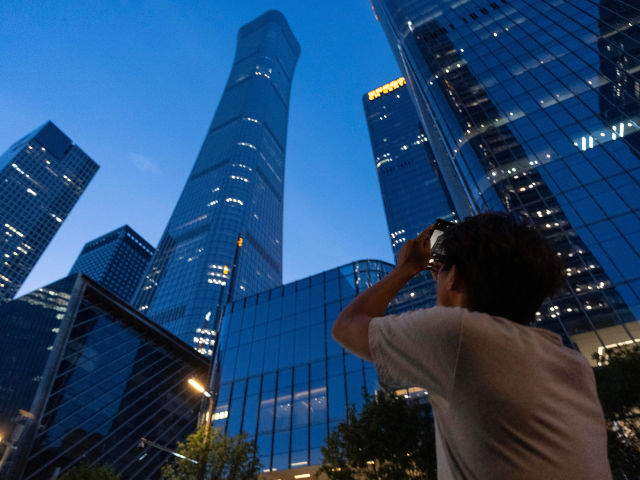
Multiple international news organizations reported Friday that a small aircraft crashed into Beijing’s towering CITIC Tower — the tallest building in the Chinese capital and one of the country’s most recognizable financial landmarks.
The aircraft was described by Reuters as roughly the “size of a car.”
Witness accounts and footage described by reporters painted a dramatic scene.
According to Hong Kong outlet Ming Pao, video showed the aircraft breaking apart after impact near the eastern side of the tower, scattering debris across the ground. Some wreckage reportedly struck the canopy at the building’s east entrance and ignited a fire.
But almost as quickly as news of the crash emerged, reports surfaced that Chinese authorities were moving aggressively to restrict information.
Reuters reported that police prevented people from taking photographs and instructed others to delete images already captured on their phones while pushing bystanders away from the area.
Bloomberg similarly reported that photographers at the scene were ordered not to take pictures, without explanation.
And then came the digital cleanup.
Reuters noted that social media posts referencing the building rapidly disappeared from Chinese platforms. Searches for the tower’s name reportedly returned only older content, with fresh discussion seemingly removed.
The state’s major English-language outlets remained notably quiet.
At press time, neither Xinhua nor Global Times had publicly addressed the incident.
That silence has fueled speculation and accelerated the spread of rumors — something governments often claim censorship prevents but frequently helps create.
Several outlets, including CNN, Ming Pao, and Turkey’s Anadolu Agency, identified the aircraft as a Sunward SA60L Aurora, a small two-seat aircraft believed to be manufactured in China.
Ming Pao reported that the aircraft was connected to Dongshi Shuangyue General Aviation, a company focused on sightseeing flights and aviation services.
Additional claims circulated online through The Great Translation Movement, an account known for translating and publishing material censored inside China. The account stated that the company may be connected through business operations to Oriental Fashion, a major Chinese driving school company that expanded into aviation and pilot training.
Those claims have not been independently verified.
The same account also pushed back against online rumors attempting to connect the incident directly to CITIC, the enormous state-linked conglomerate associated with the building. At the time of reporting, no public evidence had established such a connection, and the pilot’s identity remained unconfirmed.
CNN added another layer of uncertainty, noting that unverified flight tracking data shared online appeared to show a severely abnormal flight path before impact.
For now, basic questions remain unanswered.
What caused the crash?
Who was flying?
Was it mechanical failure, pilot error, or something else entirely?
The public does not know.
And that uncertainty is precisely why transparency matters.
Accidents happen. Investigations take time. Facts evolve.
But when authorities respond first with information control instead of information sharing, they create a vacuum where distrust grows faster than truth.
Free societies understand that confidence is built through openness.
Authoritarian systems too often seem to believe confidence can be manufactured through silence.
History has a way of deciding which approach survives.