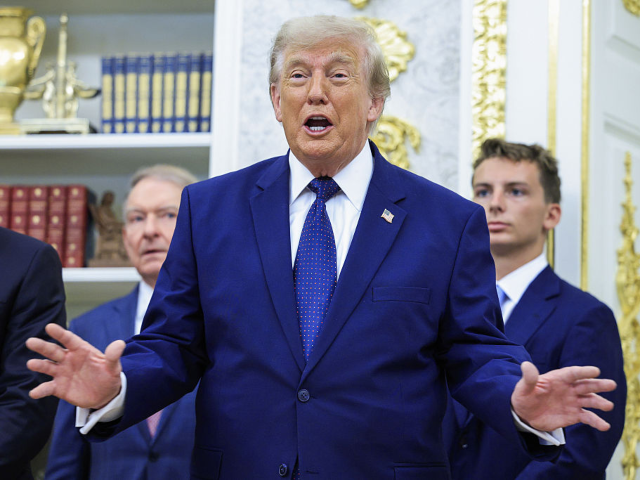
President Donald Trump is accusing Democrats of applying a glaring double standard to sexual misconduct accusations, arguing that allegations made by a woman with conservative ties were largely ignored until additional claims against Maine Democrat Graham Platner forced the issue into the national spotlight.
Speaking to reporters aboard Air Force One shortly before Platner announced Wednesday evening that he was suspending his campaign, Trump questioned why earlier accusations failed to receive the same level of attention and credibility.
“So, he won the primary… It’s very hard for them to [replace Platner],” Trump said. “It’s really a question on whether or not you believe the woman,” before adding, “A lot of people say big falsehoods.”
Platner's decision to suspend his campaign came after multiple women accused him of sexual assault. The accusations have not been adjudicated in court, and no criminal conviction has been reported. The controversy has nonetheless thrown Democrats into a political crisis after Platner secured the party's nomination in the June primary.
Trump focused less on the political fallout than on what he described as selective outrage. According to the president, allegations from a woman who worked in conservative politics failed to generate the attention or urgency that similar accusations often receive when they align with the media's preferred narrative.
For many conservatives, the controversy revives a familiar question: Are all accusers treated equally, or does credibility depend on political affiliation? Republicans have long argued that accusations involving Democrats frequently receive more cautious coverage than comparable claims directed at conservatives, while conservative women are too often overlooked when their stories prove politically inconvenient.
The timing also leaves Democrats with a difficult challenge. Because Platner won the June primary, replacing the party's nominee could become a complicated legal and political process, adding uncertainty to an already turbulent race.
As the case continues to unfold, the facts will ultimately determine its legal outcome. But the political debate has already exposed a broader issue that extends beyond a single campaign. Equal justice and equal treatment should not depend on party labels. If accusations deserve to be taken seriously, they should be taken seriously regardless of whether they help Democrats or Republicans. That principle is essential to public trust—and Americans are paying close attention to who lives by it.